
|
For all your safety sign needsOpen till late - 0208 133 6709 |
|
|
For all your safety sign needsOpen till late - 0208 133 6709 |
All smokefree premises and vehicles will need to display no smoking signs that meet the requirements of the new law. Signs will make it clear which premises and vehicles are smokefree and demonstrate that you are taking the necessary
From Sunday, 1 July, no smoking signs will need to be displayed in a prominent position at every entrance to smokefree premises. Signs must meet the following minimum requirements:
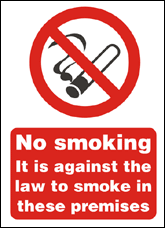
You are also free to personalise your signs by changing the words 'these premises' to refer to the name or type of premises – such as 'this gym','this salon' or 'this restaurant'.
A smaller sign consisting of the international no smoking symbol at least 70mm in diameter may instead be displayed at entrances to smokefree premises that:
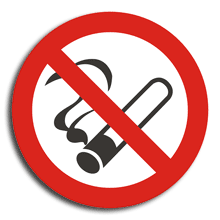
Smokefree vehicles will need to display a nosmoking sign in each compartment of the vehicle in which people can be carried. This must show the international nosmoking symbol at least 70mm in diameter.
Based on experience from other countries, we are confident that people will respect the new law. However, you will need to be prepared to take action if someone smokes in any smokefree premises or vehicles that you are responsible for. The advice is to:
You should consider not serving or providing services to a person who is breaking the new smokefree law by smoking in a smokefree place.
If a customer or visitor continues to smoke, you can ask them to leave your premises. If an employee breaks the law, you may wish to consider taking disciplinary action. If physical violence is threatened by a person smoking, we suggest you notify and/or seek assistance from the police.
The new smokefree law will apply to virtually all 'enclosed' and 'substantially enclosed' public places and workplaces. This includes both permanent structures and temporary ones such as tents and marquees. This also means that indoor smoking rooms in public places and workplaces will no longer be allowed.
Premises will be considered 'enclosed' if they have a ceiling or roof and (except for doors, windows or passageways) are wholly enclosed either on a permanent or temporary basis.
Premises will be considered 'substantially enclosed' if they have a ceiling or roof, but have an opening in the walls, which is less than half the total area of the walls. The area of the opening does not include doors, windows or any other fittings that can be opened or shut.
There is no requirement for outdoor smoking shelters to be provided for employees or members of the public.
If you do decide to build a shelter, we suggest you discuss any plans you may have with your local council, as there may be a range of issues you need to consider. These might include planning permission, licensing, building control, noise and litter.
The new law will require vehicles to be smokefree at all times if they are used:
Smokefree vehicles will need to display a nosmoking sign in each compartment of the vehicle in which people can be carried. This must show the international nosmoking symbol no smaller than 70mm in diameter
When carrying persons, smokefree vehicles with a roof that can be stowed or removed will not be required to be smokefree when the roof is completely removed or stowed.
Vehicles that are used primarily for private purposes will not be required to be smokefree.
Ships and waterborne vessels will be covered by specific regulations that are being considered by the Department for Transport. More information is available from the Department for Transport by emailing smokingonships@dft.gsi.gov.uk or calling 020 7944 5427.
In general, the new law does not cover private dwellings. However, any enclosed or substantially enclosed part of a premises shared with other premises, such as a communal stairwell or lift in a block of flats, will be required to be smokefree if:
The law does not require selfcontained residential accommodation for temporary or holiday use (for example, holiday cottages or caravans) to be smokefree. The owners, however, may choose to make the accommodation smokefree.
Anyone who visits private dwellings as part of their work, for example delivering goods, or providing services such as plumbing, building or hairdressing, can download further guidance at http://www.hse.gov.uk/contact/faqs/smoking.htm
Any part of a private dwelling used solely for work purposes will be required to be smokefree if:
Local councils will be responsible for enforcing the new law in England. In the run up to 1 July 2007, they will work closely with businesses to help ensure that everyone
Their approach to enforcement will be based on supporting businesses to comply with the new law. However, they will have the legal power to enter premises or board vehicles to determine if the new law is being upheld.
If you manage or are in charge of any premises or vehicles that the new law applies to, you will have a legal responsibility to ensure they become and remain smokefree.
A telephone line (0800 587 1667) will also be in operation from 1 July 2007 to enable employees and members of the public to report possible breaches of the law. This information will be passed to local councilsto followup as appropriate.
In other smokefree countries, such as Ireland, Scotland and New Zealand, levels of compliance are high, and the laws quickly became self enforcing. If you have any specific questions about how the new law will affect your business, please contact your local council.
Only a few premises will be exempt from the new smokefree law, and all exemptions are subject to strict conditions. Exemptions have been provided for workplaces with specific circumstances.
Exemptions are provided to allow managers to designate specific rooms for smoking in the following types of premises:
1 Care homes as defined in the section
3 of the Care Standards Act 2000.
2 Hospices which as their whole or main purpose provide
palliative care for persons resident there who are suffering
from progressive disease in its final stages.
3 Residential mental health unit means any establishment
(or part of an establishment) maintained wholly or mainly
for the reception and treatment of persons suffering from
any form of mental disorder, as defined in section 1(2)
of the Mental Health Act 1983.
4 Offshore installations as defined in regulation 3 of the
Offshore Installations and Pipeline Works (Management and
Administration) Regulations 1995.
5 Only specialist tobacconist stores that meet the definition
in section 6(2) of the Tobacco Advertising and Promotion
Act 2002.
When will the new smokefree law start?
Sunday, 1 July 2007.
Who will enforce the new law?
L ocal councils and port health authorities will enforce
the new law and will have the power to appoint enforcement
officers, such as environmental health officers, trading
standards or local community support officers.
Does the law just apply to cigarettes?
No, it covers all substances that a person can smoke. These
include manufactured cigarettes, handrolled cigarettes,
pipes, cigars, herbal cigarettes and water pipes (including
shisha, hookah and hubblebubble pipes).
Can I still have a staff smoking room?
No, but you can have an outdoor smoking shelter, although
there is no requirement for you to do so. If you decide
to, you will need to ensure it is not 'enclosed' or 'substantially
enclosed'.You may also need to consider other issues such
as planning, licensing and building control, noise and litter.
Can I smoke in my own car?
Yes, the new law doesn't cover vehicles used primarily for
private purposes.
I share a work vehicle with another smoker. Can we still
smoke?
No, the law is designed to protect smokers and nonsmokers
from secondhand smoke. Smoking will only be permitted in
work vehicles that are for the sole use of the driver and
are not used by anyone else for work either as a driver
or passenger.
I work from home. Will it be required to be smokefree?
If more than one person uses any part of a private dwelling
solely as a place of work, then it will be required to be
smokefree.
Does new smokefree law apply to premises and vehicles
used for voluntary work?
Yes, the new law applies to all work, including voluntary
work.
I occasionally use my private car for voluntary work,
will it need to be smokefree?
No, vehicles used primarily for private purposes will not
need to be smokefree.
Are no smoking signs required in heritage buildings?
Any premises required to be smokefree will need to display
nosmoking signs that meet the requirements of the new law
prominently at entrances. The new law allows flexibility
for signs to be designed and displayed in a way that fits
the décor of premises.
Where can I get more information?
For further information, visit www.smokefreeengland.co.uk
or call the Smokefree England information line on 0800 169
169 7. You can also ask your local council for advice and
support.
 Safety Signs - Owned and Operated by BCW Office Products LTD registration 05693956, VAT 900 3466 61.
(c) 2017 BCW. Website design Crawshay Gallery / Number 6 Consulting LLC All rights reserved.